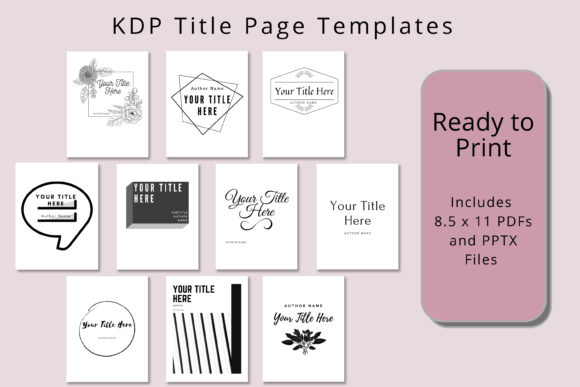
KDP Title Page Templates: Elevate Your Book's First Impression
That moment when a reader picks up your book, or clicks on its digital thumbnail, is a critical juncture. Before they read a single word of your story or content, they judge its cover. And immediately after the cover comes the title page—a space that sets the entire tone for the reading experience. A generic, text-only title page can feel like an afterthought. But a thoughtfully designed one? It acts as a subtle promise, a hint of the quality and care within the pages that follow. This is where a versatile set of KDP Title Page Templates becomes an indispensable asset for any serious publisher.
More Than Just a Placeholder: The Anatomy of Effective Title Pages
A well-crafted title page does more than state the book's name. It establishes visual hierarchy, reinforces branding, and contributes to the overall professional presentation. The strength of this particular template set lies in its curated diversity. You're not getting one style repeated; you're gaining access to a library of distinct visual personalities. Imagine a clean, sans serif font paired with geometric shapes for a business or self-help book—projecting clarity and modernity. For a historical fiction novel, a classic serif font with elegant filigree might be the perfect match, evoking tradition and gravitas. A children's book or a personal memoir could benefit from a playful script font or a handwritten font style, adding warmth and approachability from the very first page.
Each template in the collection is designed as a starting point for your own brand identity. The visual characteristics—whether minimalist, ornate, vintage, or avant-garde—provide a clear direction. You can assess which style's "personality" best aligns with your book's genre and your authorial voice. This isn't about applying a random decoration; it's about making a strategic design choice that influences reader perception before chapter one even begins. The overall appeal is one of flexibility and professional polish, allowing you to move beyond the default and create a cohesive look.
Strategic Applications Across Your Publishing and Brand Ecosystem
The utility of these templates extends far beyond the interior of a single paperback. Think of them as core design assets for a broader project. A compelling title page design can be adapted for a variety of marketing and branding touchpoints. Use the visual elements from your chosen template to create consistent social media graphics for book launches. The color palette and typographic style can inform the design of a promotional website or a newsletter header, ensuring a unified brand identity across all platforms.
For entrepreneurs and small business owners publishing workbooks, guides, or lead magnets, these templates offer a shortcut to a polished, credible look. A professional title page in a client-facing PDF or a printed manual immediately elevates perceived value. Content creators and bloggers can use them to style the covers of digital e-books or resource kits, making their free or paid offerings stand out. Even crafters and hobbyists working on personal projects, like family recipe books or memoir compilations, can add a layer of intention and beauty that honors the content within.
Practical Guidance for Choosing and Customizing Your Template
Selecting the right template from the set requires a bit of thoughtful evaluation. Start by considering your book's core genre and target audience. A thriller demands different visual cues than a romance novel or a technical manual. Look for a style that feels intuitively aligned. Next, assess the template's adaptability. The true power of these files lies in their editability within Adobe or Canva. Can you easily change the colors to match your cover? Is the font swapable if you have a specific premium font in mind for your logo design or author name? A good template should be a flexible framework, not a rigid cage.
When you begin editing, focus on visual hierarchy. Your book title should be the most prominent element, followed by the subtitle, then the author name. The template should guide this, but you have the final say in adjusting scale, weight, and placement. Pay close attention to readability. Even the most beautiful display font fails if the title is illegible at thumbnail size. Test your design by viewing it at a small scale on screen. Ensure there is sufficient contrast between the text and the background.
Finally, think about font pairing and consistency. If the template uses a bold display type for the title, consider a cleaner sans serif or serif font for the author name to maintain balance. The goal is a harmonious composition that feels intentional. Remember, the title page is part of a sequence: cover, title page, copyright page, and so on. Maintaining a consistent color scheme and typographic style across these elements fosters a sense of professionalism and brand recognition. By leveraging these KDP Title Page Templates, you're not just filling a page; you're crafting an experience, ensuring your book makes a powerful and polished first impression from the very start.